

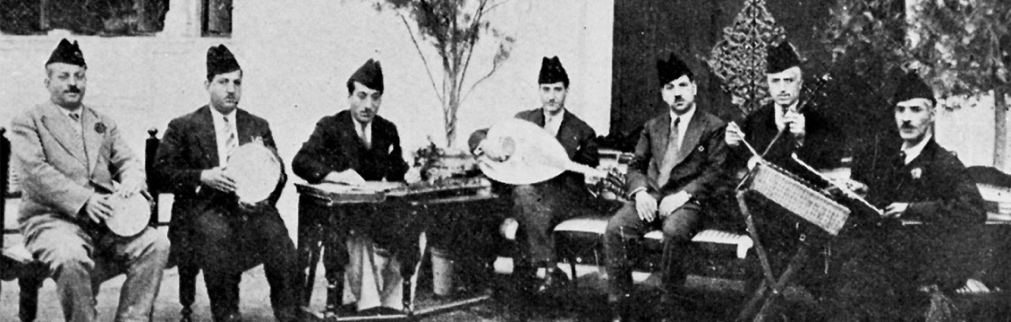
THE (DE)COLONIAL LEGACY OF THE 1932 CAIRO CONGRESS
Pyramid Room, King’s College London – Strand campus
Thursday 9 April 2026, 4:00 – 5:30
The panel brings together musicians, scholars and archivists to reflect on the legacy of the 1932 Cairo Congress from a contemporary MENA perspective. Moderated by Rim Irscheid, panelists Kamilya Jubran, Hazem Jamjoum, Tarik Beshir and Gülcin Özkişi discuss how the Congress continues to shape ideas of authenticity, notation, preservation, and musical modernity today. Drawing on creative practice and research, the panel will explore the political, colonial, and archival dimensions of this historic gathering and its ongoing impact on music-making and knowledge production in the region.
THE SPEAKERS
THE SPEAKERS
Tarik Beshir is a uniquely talented vocalist and student of the style and techniques of late 19th and early 20th century song in Ottoman Egypt. Gifted with silken tones and a tremendous range, he is one of just a handful who can faithfully recreate the sound of this period of renaissance. He is also a skilled oud player and songwriter who’s been plying his trade now for over 20 years. He plays the oud in the Egyptian style and the Mohammed Qasabji School of oud technique in particular.
Hazem Jamjoum’s work aims at digitizing, cataloguing and contextualizing this part of Arab communities’ audio heritage. He has also co-lead a project aimed at identifying similar at-risk audiovisual collections in the region with the longer term aim of fostering such preservation and curatorial work on a wider scale. His doctoral research in history at NYU traces the connections between the production of “Arabic music” as a concept and a commodity, and the implications of these production processes on supra-state collective identifications, pan-Arabism in particular.
Kamilya Jubran moved to Europe in 2002 after her long career as the lead singer and qanoun player with the monumental Palestinian group Sabreen. Werner Hasler and Sarah Murcia featured in her first solo project Mahattaat in Switzerland in 2002, since then both becoming her main musical collaborators. Her collaborations with other artists include Sylvain Cathala, Mela Meierhans, Sawsan Darwaza, Mark Tompkins and Jon Balke. Jubran is the artistic director for Zamkana Association, which she also co-founded in October 2014 in Paris. Zamkana supports and accompanies original innovative artistic projects, supporting freedom of expression and secularism.
Gülçin Özkisi, a London-based academic and musician from Turkey, is currently a Research Fellow in Music at King’s College London. She received her PhD from Yıldız Technical University in Istanbul. Between 2011 and 2013, Özkisi was a postdoctoral researcher at SOAS University of London, the University of Oxford as a TÜBİTAK scholar, and later at King’s College London under the mentorship of Martin Stokes. She was a faculty member at Yıldız Technical University’s Faculty of Art and Design from 2005 to 2020 and was made Associate Professor in 2017. Her research focuses on music and gender, as well as performance and compositional practices of the twentieth century and beyond.
Rim Irscheid is a postdoctoral researcher at King’s College London, working on experimental music and archival interventions across Middle Eastern contemporary sound and visual arts. Combining ethnographic research and curatorial practice, her practice-based research is looking at artist-led institution building, emotional aspects of creative labour, and interpretations of care and solidarity in curatorial activism.
THE VIDEO
THE VIDEO