
Intro
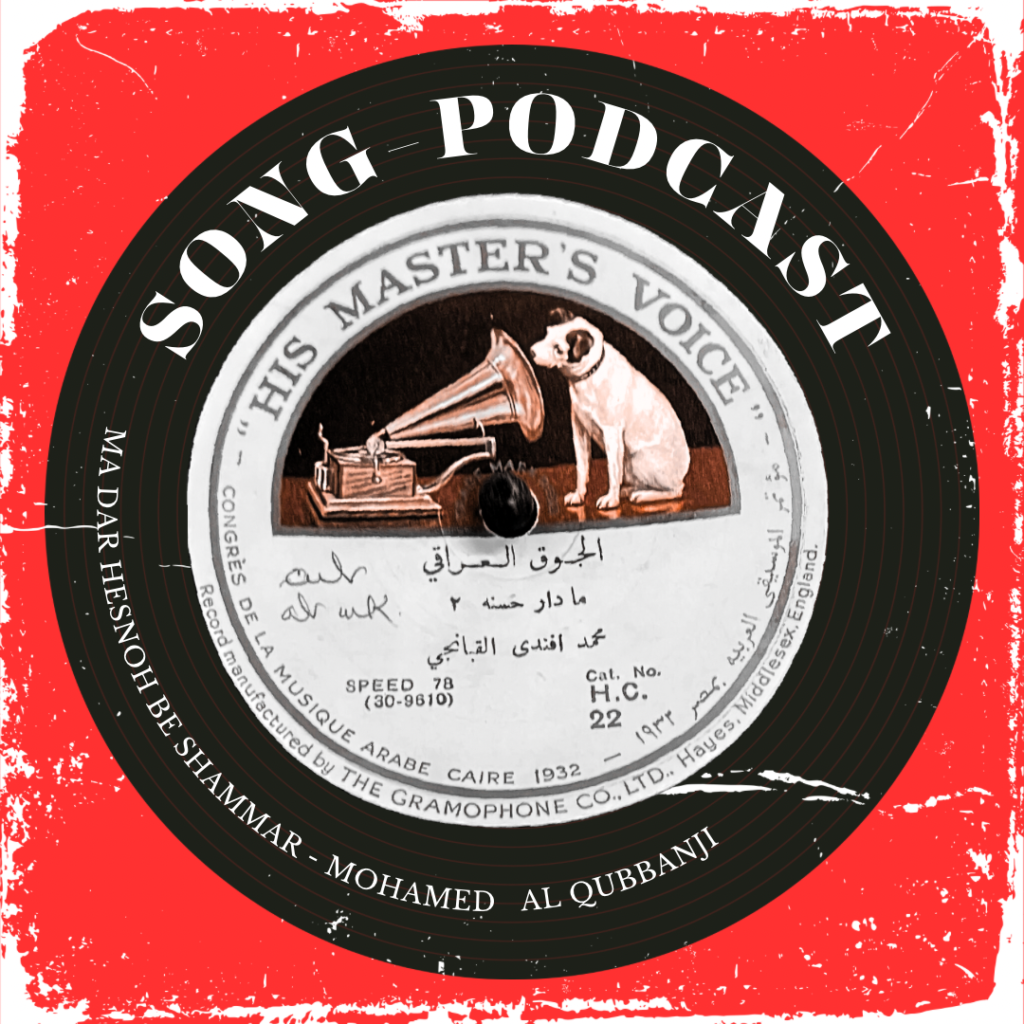
A song-podcast follows a simple principle: dedicating one podcast to a single recording from the 1932 Cairo Congress. Contemporary artists, researchers, and experts choose a recording and explain the reasons for their choice, followed by the original piece in its entirety.
Jean Lambert, a French ethnomusicologist, has agreed to talk to us about a dialectal poem entitled Madar hesno be Shammar (‘Never has such beauty been seen, not even amongst the Shammars’). It is a piece in the Iraqi maqam genre that was performed in Cairo by Mohamed El Qubanji’s ensemble from Baghdad.
Jean welcomed us at his home in Paris on 5 April 2024. He describes here El Qubanji’s orchestra and explains the aesthetic reasons behind his choice. It is worth noting that, in terms of numbers in the Cairo Congress recordings, the Iraqi maqam is second in importance only to the Egyptian repertoire.
Interview
I’d like you to listen to a vocal piece recorded during the 1932 Cairo Congress of Arabic Music by the Iraqi singer Mohamed El Qubanji. He was a truly great singer who had been selected by the court of the then King of Iraq (ed.: Faisal I), and he was accompanied by four, or perhaps even five or six, instrumentalists.
So, as we’ll hear in this track, there are actually two types of instruments: there are the traditional maqam instruments of what is known as the Tchalghi Baghdadi – the traditional orchestra of Baghdad or urban Iraqi music – which include the santur, a small zither struck with hammers, which is usually of Iranian origin. (There aren’t many santur in the Arab world, but in Iraq it’s traditional). Obviously, it’s very close to Iran, so that’s hardly surprising.
And also, the jaouza, which is a traditional fiddle, probably made with a coconut as the body, mounted on a neck and having two or three strings. So, these two instruments were traditional in the Tchalghi Baghdadi, along with percussion. There are also two percussionists.
And they have added to this traditional orchestra, in the spirit of modernism, two instruments that were more commonly played in Syria and Egypt: the kanun – which is also a box zither, but larger – and, unlike the santur, which is played with hammers, the kanun is played with plectra.
So, we therefore have two different types of zither, and then of course the oud, which was really an instrument in full development at the start of the 20th century, and which was therefore beginning to spread in Iraq, probably in the late 19th or early 20th century.
They probably had the idea – in the spirit of modernism – to bring these two small instrumental ensembles together to present, perhaps not just a traditional concept of Iraqi music but also an ‘arabised’ one, since it was the Arab Music Congress.
In a way, each Arab country had to take a few steps towards the others to arrive at a more or less unified concept of this Arab music that the Congress set out to establish in 1932.
So, I’ve chosen a piece form based on the basté or pasta – پستة (It depends on how you pronounce it, in the Persian or Arabic manner). It’s a form sung in the Iraqi dialect, but one that was gradually introduced into the urban music of Baghdad, whereas initially it was probably a rather rural or Bedouin form of song.
And indeed, the title of this song illustrates this, as it alludes to the Shammar tribe, based in southern Iraq on the border with Saudi Arabia. The title of the song is Madar hesno be Shammar – meaning ‘We’ve never seen anyone as beautiful, not even within the Shammar tribe’. \
Naturally, it is a love poem that speaks of beloved, and is thus a way of both praising the Shammar tribe and, at the same time, finding a metaphor even more beautiful than the well-known beauty of the women of Shammar – that is, Bedouin women, of course…
It is, in fact, the perspective of city-dwelling musicians on Bedouin girls, who possess legendary beauty because they are considered more natural. They don’t wear make-up like city women, but on the other hand, they have big dark eyes with very fine eyelashes, and so on.
Well, there’s a whole imagery like that running through this song, which is actually present in many other songs of this type, and which also illustrates well the relationship between city-dwellers and Bedouins, so that’s interesting in itself.
Then there’s another aspect too that’s very interesting in many of the pieces El Qubanji sung. He did, after all, record over two hours of music on that occasion, and what’s really beautiful is that he makes extensive use of ‘meaningless’ syllables found in many Arab traditions to this day.
They’re called all sorts of things like taranomat, I can’t quite recall the exact term used as every tradition has its own terminology to some extent, and in this particular case, there’s notably – you hear Yuba, yuba, which actually means yaba, probably ‘O my father’, but which has been altered specifically for the purposes of the song.
So, with the syllables at the end, we can’t actually understand what the original meaning of these syllables, which are therefore very commonly used in Iraq, but are also very common in Morocco and in all the Andalusian traditions of North Africa.
In fact, they’re extremely common in Yemen too. Having worked a great deal in Yemen myself, this is something that interests me greatly because they vary so much from one tradition to another. The best-known ones, of course, in Egypt are Ya layl, ya ayn (‘O night, O eye’), but in fact they’re incredibly varied – even far more so than in Egypt, for example, where you hear Ya layl, ya ayn a great deal. There you have it: these are things that add a great deal of beauty to these songs.
FG: To conclude, I noticed you were smiling whilst talking about this recording. Why did you choose this specific song to share with the audience?
JL: Well, it’s also because it’s quite slow, so you can hear the instruments quite clearly; sometimes, let’s say, they don’t necessarily play in unison all the time, so there are little heterophonic effects that also allow you to hear each instrument more clearly.
You’ll see, you’ll hear that each one plays their own little part whilst coming together at the end of a musical phrase, and that’s very beautiful too. And so, as the piece is slow, it lends itself well to that, and you can really hear those elements clearly.
FIND OUT MORE
Iraqi maqam : Unesco Intangible Cultural Heritage of Humanity, 2008.