

Introduction
This blog post is a translation from the French of our podcast episodes called Conversations. It documents the work of researchers and experts involved in preserving and promoting the recordings of the first Congress of Arabic Music held in Cairo in 1932.
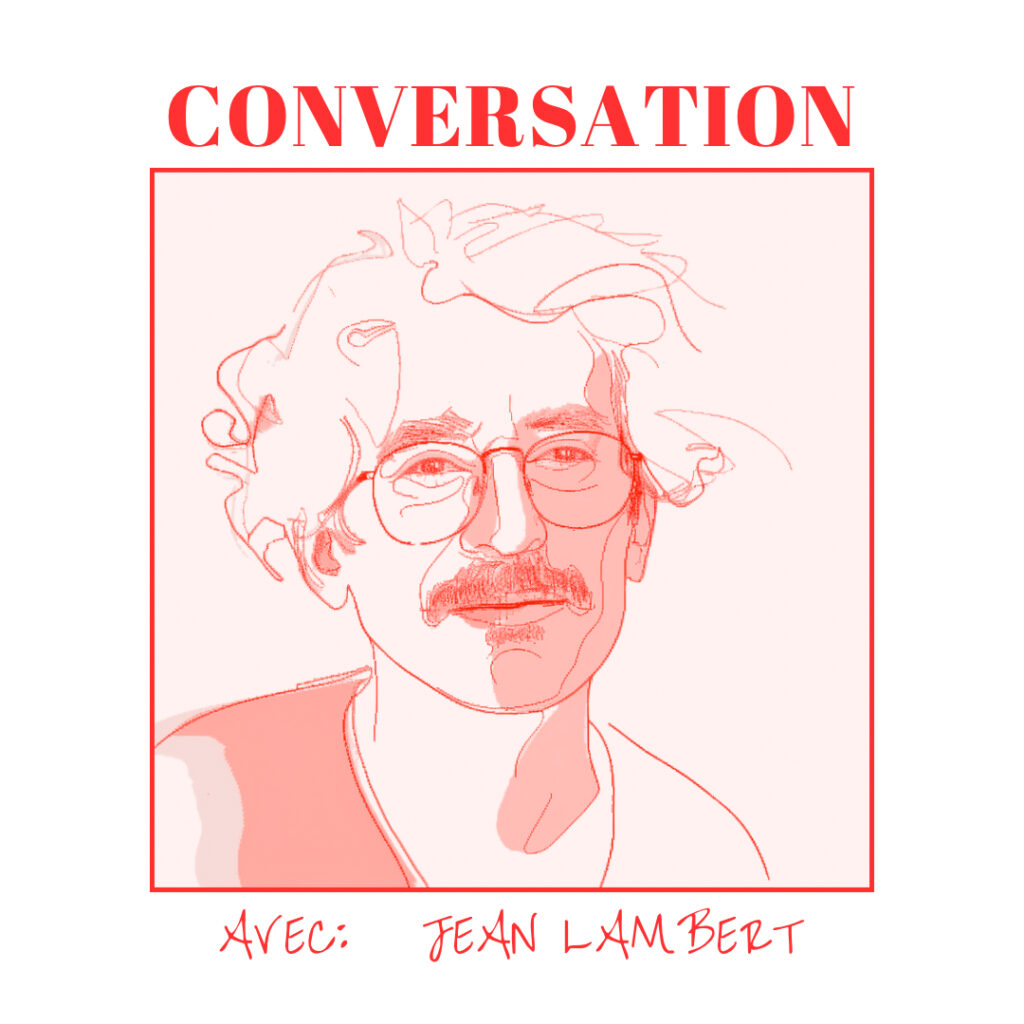
We continue this series with the ethnomusicologist, Jean Lambert. He discusses his involvement in the publication of the Cairo recordings, following in the footsteps of Bernard Moussali. He also looks back at the debates that punctuated the congress in a post-Ottoman, colonial and nationalist context. Finally, he gives us a brief artistic overview of Yemen in the 1930s.
We met Jean Lambert at his home in Paris on 5 April 2024. He shared his time and knowledge with us while we waited to read his latest book related to the Cairo Congress, eventually published in December 2024.
Interview
JL: So, I am an ethnomusicologist, but you could also look at it another way and say that I am both an anthropologist and a musicologist. I have developed my own approach to the relationship between the two; many of my colleagues may have a different approach.
But broadly speaking, we could say that it is, above all, about understanding music in its cultural context, if we were to define ethnomusicology very briefly. So, I taught and did research at the Musée de l’Homme in Paris for a long time, as well as at the University of Nanterre. Yemen was indeed a very important moment. That’s where I did all my student research, for my Master’s and Doctoral thesis. And then, well, let’s add that I had actually studied Arabic in France before I got to know Yemen.
Then I had the chance to go to Yemen, and when I discovered this wonderful country, I continued my studies to improve my skills. I finally did some research and found a thesis topic. It was Yemen that opened my eyes to this world, both musical and poetic, and Arabic-speaking.
FG: We would like to know what was your involvement in the National Library of France project regarding the publication of the Cairo Congress recordings?
JL: Well, it’s quite a long story…It wasn’t my research project to begin with. It was the research project of a colleague, also a friend of mine, called Bernard Moussali, who died in 1996. He had been working on the Cairo Congress since the late 1970s. In other words, for at least 20 years. He died far too young, sadly, so he was unable to finish his thesis. Luckily, I was able to recover both his recordings and all of his thesis work, only a part of which consisted of comments on and documentation of the Cairo Congress recordings.
In fact, what we published with the National Library of France [eventually took shape] with the financial support of Abu Dhabi’s Ministry of Culture, as well as with a certain vision of things supplied by my friend Chérif Khaznadar, who is still the honorary president of the Maison des Cultures du Monde. So, we had this idea of publishing his recordings of the Cairo conference in their entirety – which involved a major financial investment.
We had to find the money. It was thanks to Chérif Khaznadar that we found the funding from Abu Dhabi. However, the recordings were held by the Bibliothèque Nationale de France, who had inherited them from the Phonothèque Nationale de France and had therefore received a complete copy of the Cairo Congress recordings as a gift, as had the British Library and the Museum of Ethnology in Berlin.
These three major institutions possess original copies of these recordings. So, of course, it was absolutely necessary to publish the recordings together with the Bibliothèque Nationale de France. It should be noted that Bernard Moussali had [long] wanted to do this, but he was unable to do so precisely because CD technology was not then sufficiently advanced. So, it was the early days of the CD.
They did manage [earlier] to produce a two-disc box set published by the Institut du Monde Arabe and the BnF, which means they had already worked together. It’s a small box set of two discs, but it’s very well done. At the time, Moussali was able to do it with his own commentary and that of Christian Poché, who was his colleague and who worked at the Institut du Monde Arabe, dealing specifically with Arabic music. So, it was the continuation and realisation of Bernard Moussali’s dream, in fact, to be able to make this box set. With the evolution of the CD technology, it didn’t cost very much. Finally, we were able to do it in 2015.
FG: To put it in a nutshell, the proceedings of the Cairo Congress were published in 1933-1934, and the recordings were only made available in 2015, some 80 years after the Cairo Congress ?
JL: Exactly. Except that some excerpts had been broadcast on Egyptian radio in the 1930s. There was also a partial publication by what was called the Club du Disque Arabe, which was a record company run by Mr Hachlaf, based in Paris, which published many Arab world classics. They had made some excerpts that were also good, but on the other hand, the documentation was very poor.
So, the advantage of this complete collection was, of course, that it included all of Moussali’s documentation, which he had worked on for years and which was entirely complete. So, we were able to get this done thanks to the goodwill of institutions and individuals.
FG: Is it possible, in broad terms, to take stock of what this Congress really achieved in terms of music, that became ‘Arabic’ after having been ‘Oriental’ only a few years earlier? … and what was the added value of this Congress in terms of the changes that would come about in Arabic music in the decades that followed?
JL: Yes, that’s the big question. So, that was the big question Bernard Moussali was asking himself because, in fact, he had already done all this work on the recordings in 1980 for his Master’s degree, but he was preparing a Doctoral thesis that he was unable to finish and which was halted in 1996, but which was already very advanced. So, what interested him was precisely this aspect of musicology and thinking about music, the conception of Arabic music and, above all, how the debates at the Congress had unfolded.
This is a book I am currently preparing, which I hope will be published soon [eds. note: see to find out more], on the Congress of Arab Music, containing all the details of the discussions among musicologists, including Egyptian, Arabic, and European musicologists, as well as European composers who were not necessarily musicologists.
So, it’s a collection, a look at the great figures of the time, including people like Béla Bartók, whom everyone knows. The debates were very rich and interesting, ultimately focusing on the question: what is ‘Arab music’? In fact, before this, we only talked about ‘Oriental music’. At the outset, the term being used was the ‘Oriental Music’ Congress. And then, during the Congress itself, it was agreed that it should be called the Arab Music Congress, since they were in the process of trying to create a new music, which is Arab music.
So, there are many aspects to this. First of all, there is the national aspect, i.e. the Arabs had just separated from the Ottoman Empire, and therefore from the Turks, with whom they had a great deal in common. Of course, the language was different, but many Arabs were educated in Istanbul. Many Turks came to Cairo at the invitation of the kings of Egypt, called the Khedives. So, there was a great deal of exchange, and therefore, for the Arabs, it was necessary to separate themselves from this Ottoman tradition.
It was not easy because there were things that were purely Arab and others that were purely Turkish, or at least not Arab at all, including all instrumental music. The pieces known as bashraf and samai were not composed by Arabs. They were composed either by Ottoman Turks, or by composers from the various minorities, such as Jews, Christians, Greeks and Armenians. And so, the Arab Music Congress consisted in particular of Arabising these instrumental pieces.
FG: How do you explain that Mesut Cemil Bey, a Turkish tanbur player, was invited in this post-Ottoman era, while the Arabs wanted to separate more from the Ottoman Empire?
JL: Yes, but it was very difficult to separate from it, and they invited both Mesut Cemil and the great musicologist Rauf Yekta. Let’s say that the initial vision for creating this Arab music was, to a certain extent, a universalist desire to recognise its sources, its Turkish sources. But at the same time, I think there was another trend which, during the Congress itself, tended to break away from Turkish tradition.
This was also evident in the debates, even on a fundamental point such as the Arabic scale. Is there such a thing as an Arabic scale? And is it the same as the Turkish or Ottoman scale, or not? There was a lot of discussion about this, and it was precisely these things that happened during the Congress, which lasted three weeks, that made them realise that we don’t have the same scales as the Turks at all. So that’s when the separation took place, particularly at that moment. And so, suddenly, we stopped talking about ‘Oriental’ music and started talking about ‘Arabic’ music.
The scales are different in that some degrees or intervals are slightly different. Not enormously, but still, it matters a great deal in practice and in feeling. And then, we were also talking earlier about tarab [eds. note: ‘enchantment’]. There is also the fact of feeling completely at home in a familiar tradition, etc. And so, if a note is a little higher or a little lower than what we are used to, it can be shocking. And so, there you have it, we are no longer in the same world at all.
And so, this concerns in particular the notes referred to Mi and Si (specifically, in Arabic, Mi-Si-ka and Si-Si-ka), which are notes that produce intervals, roughly speaking, that can be described as ‘quarter tones’. But in fact, in all traditional music, both Turkish and Arabic, they are not really three-quarters of a tone. They are slightly higher or slightly lower, depending on the tradition. And so, they realised that the Turks and Arabs’ Mi and Si were not the same.
In fact, even those of Cairo are not the same as those of Damascus, which are not the same as those of Aleppo. So it was complicated. And to unify the Arab music, we had Aleppo, Damascus and Cairo, which had different [intonations of] Mi and Si. And so, there you have it. The debate was very heated. In the end, there were quarrels, even insults between, basically, those who wanted to stick to tradition who said: “But we’ve always done it this way”. And those who said: “Listen, it’s too complicated. Arabic music needs to modernise to move forward, especially to be able to compete with European music, which is invading us”.
So, to save Arabic music, it must be standardised. And so, we say three-quarter tones. And that’s it, we stick to ‘quarter’ tones. This allows us to divide the scale, not into 12 semitones as in the West, but into 24 quarter tones. So, suddenly, this also gave them hope of being competitive with European music because suddenly they could do things that Europeans couldn’t do, which is a very good idea. And, in fact, there were also theorists of quarter-tone music, European theorists who were present at the Congress and who supported this idea, like the Czech composer Alois Hába, among others. So, those were the debates.
There is also the debate about instruments, of course. Do we accept the violin or not? Do we accept the piano or not? There were people who made pianos, who came with their pianos, quarter-tone pianos, etc. And so the question of instruments was also important. And that was really what the main debate came down to: this is Arabic, this is not. This isn’t Arabic, this is Turkish or Ottoman and we don’t talk about it anymore. And our music is like this and must be like this.
And one of the very important driving forces behind this evolution, on the modernist side, was in fact Oum Kalsoum, as a performer. She was young, but she was very present at the Congress. She sang for the Congress participant. And then, above all, there was Mohamed Abdelwahab, who was often Oum Kalsoum’s composer, but who was also a modernist composer who was keen to modernise the Arabic scale, saying that if we want to create harmony like the Europeans, we must simplify this scale. We can’t always maintain a q of a tone. So, Abdelwahab was also present at the Congress and strongly defended this idea of standardising the Arabic scale.
FG: It seems he was very present at the Congress, but that he wasn’t listened to at all because he wasn’t a member of one of the Committees?
JL: No, no, absolutely. In fact, let’s say he wasn’t there the whole time because he had a trip at the same time. He was criticised for not being there continuously. But anyway, the modernists, who were at the Congress the whole time, were greatly inspired by Mohamed Abdelwahab as a composer. They could see that he was someone who was on the rise, who had a future. And also that the factor that drove modernism was the evolution of musical language in line with the evolution of technology.
Abdelwahab thought in terms of theatre and cinema. He said that we need music that can be illustrative, taswiria. And that’s extremely important because it’s true that when you look at film music, you can’t just use tarab music. Because tarab is really for listening to with friends, over a good drink or with a shisha.
But if you want to make music to accompany a cinematic action, you certainly can’t stop there. For example, if you want to create fear because there’s a dramatic moment in the story, you need music that creates fear. And tarab music wasn’t like that at all. So that’s what he was thinking about. Music that evokes thunder for example, or that is a little illustrative, which can, with many instruments from the symphony orchestra, illustrate with special percussion instruments, aluminium sheets that are banged together to make thunder. That’s what he was thinking about.
And I think both points of view were entirely defensible. The traditionalists defended the tradition of tarab, the interaction between the musician and a very small, intimate audience. And people like Abdelwahab, who defended adaptation to the rapidly evolving technologies that were, of course, appearing in Egypt at that time.
FG: You mentioned a book in preparation on the Cairo Congress. What will it bring that is different from what has already been written on the subject?
JL: Well, yes, that’s precisely what’s interesting, because there was a book published by Philippe Vigreux in 1992, after a symposium organised by Scheherazade Hassan Qassem at the CEDEJ[1] in Cairo in 1989.
That book contributed a great deal, particularly in terms of commentary on the recordings. There is a certain amount of redundancy between the 2015 box set and the CEDEJ texts. On the other hand, there is not much about the debates. Except for what Philippe Vigreux also contributed, which is magnificent, it is a huge press kit, of which there are only excerpts in the 1992 book, but a very large press kit that is unpublished and shows how the Egyptian press at the time was also discussing all these issues.
But no one had yet talked about the internal debates. At least, we didn’t have the information. And Moussali, who was a very good Arabist, read all the Arabic texts that bore witness to these debates. So, what will be interesting is precisely all these reports of the debates, especially in Arabic-language publications.
FG: And with the benefit of hindsight, 80 years after the Congress was organised, a naive question: can we say that Arabic music exists?
JL: It is an issue that my book is also raising. Moussali started to work on it. But I still think he had very good insights into identity. What is Arab identity? What is the musical identity of the Arabs? What is the identity of Arab music? He asks the question, why there was no music from Arabia at the time. Well, that’s understandable because those regions were completely ignored, even by Arabs. There are a few accounts from Lebanese people who travelled to Arabia or Yemen. It’s as if Europeans were to travel to Papua New Guinea. So that’s understandable. But then the question is, what do Cairo, Fes, Baghdad and Damascus have in common?
Well, what they have in common is that we are talking about urban music. We are not talking about folk music, which is already very important. There are a few recordings of Egyptian folk music in the Cairo Congress recordings, but not many. Even the Egyptians weren’t really interested in it. It was only because the Europeans told them that there was popular music that they felt obliged to record it. So, they did, fortunately.
But above all, when we talk about Arabic music, we are talking about traditional urban music. And it’s praised insofar as there is a body of musical treatises that discuss scales, modes, and even rhythms at times. So musical theory that dates to some very great writers and musicologists from the very beginnings of Islam, with Avicenna, al-Kindi, Safi al-Din al-Urmawi. These are truly great names, thinkers who really thought about music from a physical point of view. So that’s what Arabic music was at the beginning, as classical and scholarly music.
Now, the problem is the unification of the Arab world itself. And here, what is very interesting is that we come back to the very question of Arab identity outside of music, that is to say, what do the Arabs of Egypt, Morocco, Saudi Arabia, Iraq and Yemen have in common?
This is very problematic because when we look at the music, we see that it has a lot in common, but also a lot of differences. This obviously illustrates the evolution of the Arab world over fourteen centuries, with the geographical expansion of countries as far away as Andalusia. So, is there such a thing as Arabic music? We don’t know, nobody knows. I tend to say, let’s talk about Arab musics [in the plural], Arab musics as such, which is closer to reality. But I don’t know if this idea will be well-received by the public, we’ll see. In any case, it is what is expressed in the book.
FG: When I listened to the Cairo recordings, I was struck by what I perceived as a strong Maghreb presence (I imagined it would be peripheral and not very prominent). Apart from the Maghreb countries represented with their urban music, we notice a significant presence of Iraq and an over-representation of Egypt. Syria was, on the other hand, under-represented with only one artist recorded and artists from Lebanon, Palestine, Sudan and the Gulf countries were completely absent. How do you explain that?
JL: Quite right. That’s exactly what I analysed in my comments on Moussali’s book. First of all, there’s what Philippe Vigreux initially called Egyptocentrism, i.e. the fact that even back then, Egypt was positioning itself as the centre of the Arab world and the driving force behind Arab nationalism.
This is what we saw develop later with Gamal Abdel Nasser. In fact, he was really a continuation of the 1920s and 1930s. Why? Because geographically, Egypt has a central position, that’s obvious. But it also had a very central position culturally and economically, particularly because of the digging of the Suez Canal. It was therefore a rich, very open place, which allowed for enormous influence from all over.
This centrality was really illustrated through this conception of Arabic music. In a sense, the Arab music congress is also the Egyptian Music Congress that doesn’t say its name. There is also a kind of competition between Egyptian nationalism and Arab nationalism. And this is also reflected in the debates I mentioned earlier, which will be analysed in detail, particularly in the contributions of a musicologist named Mahmoud El Hefny and another lesser-known author. We can clearly see that one illustrates Egyptian nationalism and the other Arab nationalism.
Indeed, there is an obvious imbalance, even though the Maghreb has a significant presence. That is, the three countries of Algeria, Tunisia and Morocco. Basically, the three great Arab-Andalusian traditions. This is partly because these countries were occupied by France and there was a great French musicologist in Tunis, Baron Rodolphe d’Erlanger, who was largely responsible for the idea of holding a Congress on Arabic music. Unfortunately, when he was in the process of helping to organise it, he was already ill. In the end, he was unable to travel from Tunisia [to Cairo]. But he had also worked on preparing the Tunisian delegation, at least, and probably also a little on the Algerian and Moroccan delegations. And so, indeed, the three Maghreb countries were well represented.
Iraq goes back a long way. I can’t say exactly why. Perhaps because the Iraqis had a certain degree of autonomy from the British. And they had a certain legitimacy to say, ‘Look, we have great music, it absolutely must be represented’.
So why weren’t the Syrians there? That’s extremely interesting. I’ve also written about this, and it will also be written about in Moussali’s book, and I’ve talked about it elsewhere too. Here, it’s also a kind of hijacking of Syrian music by the Egyptians. In other words, much of the Arab Egyptian music at the Cairo Congress was actually of Syrian origin. And since many Lebanese and Syrians had been coming to Cairo since the 19th century, precisely because it was a place of great economic wealth, people were attracted to come and work there.
There were many musicians there who had brought their own traditions from Lebanon and Syria. One had a very unusual background. His name was Ali Darwish. He had initially studied in Istanbul and Turkey, so he spoke perfect Turkish. He was a nay player in the Mevlevi brotherhood. Then he returned to Syria at the time of Syria’s semi-independence, the separation from the Ottoman Empire and the French mandate.
Ali Darwish was then invited by the Egyptians because they understood he had a perfect command of the entire Ottoman repertoire I mentioned earlier. So, they invited him specifically to integrate his entire repertoire into future Arabic music. He was also invited by the Baron d’Erlanger in Tunisia to prepare for the Cairo Congress. Then he returned to Cairo. He had yet another extremely brilliant career until the 1950s.
So here is a figure who also played a key role, but as he was employed by the Egyptians – according to what Moussali thinks (i.e. the person who formulated this hypothesis) – Darwish didn’t dare say too much as a Syrian. So, he gave them his entire repertoire and didn’t criticise them by saying, in effect, ‘You’re stealing my repertoire’. At the time, Syria wasn’t even independent. It was largely through Ali Darwish that the entire Syrian repertoire was incorporated into the Egyptian repertoire. But as a result, he was ignored by the Congress.
A few Syrians were invited. Apart from them, not many recordings were made because they were considered too modernist, as the focus of the recordings was traditional music. They didn’t want to record modern music. So, there was also an ambiguity or even tension between recording traditional music and discussing the construction of modern and modernist music. That’s basically why we discovered Syrian music only much later. We discovered Syrian music in the 1980s with Sabri Moudallal, for example. But at the time, no one knew about it.
FG: So, there was a tradition [in Syria], but it was completely obscured…. So, speaking of other absentees in Cairo, why not talk about Yemen, a country you know very well? Could you give us an idea of who the famous Yemeni artists were in the 1930s, some of whom were even recorded by local record companies?
JL: Yes, of course. In fact, the dates speak for themselves: there was the Music Congress in Cairo in 1932, and commercial recordings in Yemen began in 1935. So, three years later, and that’s no coincidence. It’s because there was interest, enthusiasm, and record companies were already operating in Yemen. There were already Egyptian records in Yemen, probably even before electric recordings, so probably already with hand-cranked gramophones in the 1920s. So, Yemenis were already listening to Egyptian music.
But in 1935, Odeon and another German company started recording. And as war was looming, Odeon itself was divided between the United Kingdom and Germany. There were conflicts and they withdrew very quickly. On the other hand, thanks to this first experience, several local companies were created as a result and recorded many musicians, even before the Second World War. It was very short. Between 1935 and 1939, in four years, they recorded about 1,500 records. And after the war, they started again in 1950. They recorded for maybe another five years, since 78 rpm records didn’t last that long, but it continued.
This music has been known to us since the 1930s, around 1935, thanks to these recordings made in Aden, which was the capital of the British colony of Aden, the world’s leading port at the time (bigger than Marseille or Rotterdam). It was quite a place, which also depended largely on the Viceroy of India. It was at the centre of the trade between India and the United Kingdom. And that explains its importance and thanks to that, we have all these recordings that have undergone a lot of vicissitudes, but on which I have worked with a Yemeni colleague.
We made an inventory and published two books (one in English and one in French) and we continue to work on these early commercial recordings. They really give an idea of the urban music, mainly, like the early recordings in Egypt and the Maghreb. It was [indeed] mainly urban music at the beginning. But for the time, it’s already very good from all over Yemen, not just the capital. And these are also recordings that have been copied and recopied onto cassette and magnetic tapes. And all musicians listen to them now. In other words, it has really become Yemen’s national musical memory. I think it’s also wonderful for Yemen to think that these recordings, made between 1935 and 1955, already represent the entire musical memory of Yemen.
FG: And now that you’ve made me curious, who were the most famous artists? Women or men? What genres did they sing? Because I can’t listen to anything at the moment, but can you help us understand this artistic Yemeni microcosm?
JL: Absolutely. So, the oldest and most classical music in Yemen is called Sanaa song or ghina sanaani. There were some great singers who sang this, notably Ali Abu Bakr Bashrahil, Saleh Al Antari and Ibrahim Mohamed Almas.
Then there was another genre that was close to the city of Aden, but a little outside and very traditional, called Lahdji, from a city called Lahdj. And they were recorded at almost the same time in 1935, 1936 and 1937. Lahdji is more popular, less ancient, but very lively and joyful. It’s also a genre that is danced to a lot and is very beautiful.
At the same time, but recorded a little later, there is what is called Hadrami, which comes from the Hadhramaut region. There was a great singer there called Mohamed Jumaa Khan from a great tradition in a very rich and distinctive region of Yemen, Hadramaut.
And the fourth major part was Adani, but that came a little later because it was actually urban music from Aden that was created during that period, but in a way ‘the others had their tradition, we didn’t have one, so we created it’. Their music was also very much inspired by Egyptian music, a little by European music, as well as by local music. It’s a kind of synthesis called Adani. And so, basically, there are these four major regional Yemeni traditions in these recordings up until 1955.
[1] Centre d’études et de documentation économiques, juridiques et sociales (CEDEJ) is a Cairo based multidisciplinary research institute working on contemporary Egypt from within the humanities and social sciences. https://cedej-eg.org
TO FIND OUT MORE
Jean Lambert playing qanbus (yemeni lute). https://www.youtube.com/watch?v=Nhqj70vMbMI